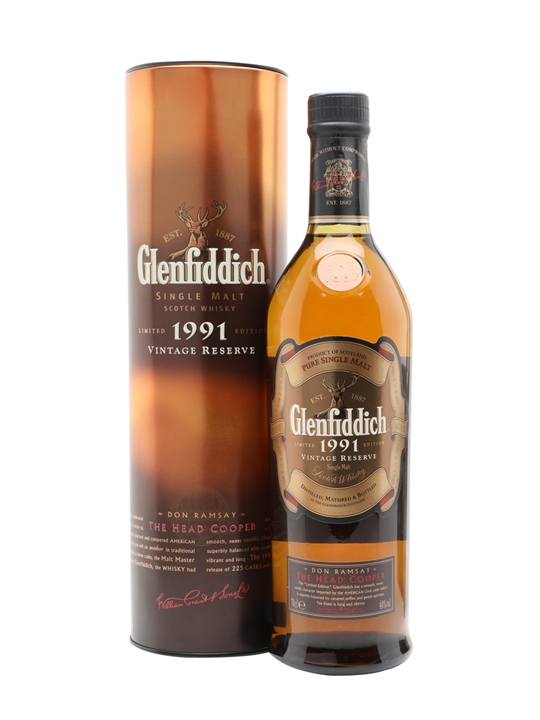

There are bottles that sit quietly on the shelf, waiting for the right moment to be understood. The Glenfiddich 1991, bottled in 2004 under the Don Ramsay label, is precisely that kind of whisky — a thirty-year-old Speyside that spent over a decade maturing before it was deemed ready, then another two decades gathering dust and reputation in equal measure. I have had the privilege of sitting with this dram, and it demands a considered assessment.
A 1991 vintage from Glenfiddich bottled at 40% ABV after three full decades in cask is, by any measure, a serious proposition. The Don Ramsay bottlings occupy a particular niche — independent or special-release expressions that capture a specific moment in a distillery's output. What you are buying here is not simply age, though thirty years commands respect. You are buying a snapshot of Glenfiddich's spirit character from the early nineties, a period when the distillery was operating at enormous scale yet still producing remarkably consistent new make. At 40%, this has been brought down to a gentle strength, which tells you the bottler's intention was approachability rather than cask-strength intensity.
What to Expect
Speyside at thirty years tends toward a particular register. Extended maturation in this region's climate — cool, damp, unhurried — draws out layers of orchard fruit, beeswax, and old oak. Glenfiddich's house style has always leaned toward a clean, slightly fruity spirit, and three decades of wood contact will have deepened that considerably. At 40% ABV, expect a whisky that is soft on the entry, rounded, and perhaps more delicate than you might anticipate from something with this much age. The lower bottling strength means the oak influence will present as integrated and polished rather than aggressive. This is a whisky that whispers rather than shouts, and you will need to pay attention.
The Verdict
I am giving this an 8.1 out of 10, and I want to be clear about why. Thirty-year-old Glenfiddich from a quality vintage year is genuinely rare. The 1991 distillation, allowed to mature until 2004, represents patient cask management and a willingness to let the spirit dictate the timeline. At £350, it sits in a competitive space — there are younger whiskies asking more, and older ones offering less character. The 40% ABV is the only point where I pause; I would have preferred to see this at natural strength, where the full complexity of three decades could speak without dilution. That said, what remains is still a refined and rewarding Speyside of real pedigree. For collectors and serious drinkers who value provenance and age, this bottle justifies its price. It is not a whisky for showing off. It is a whisky for sitting with, quietly, on an evening when you have nowhere else to be.
Best Served
Neat, in a tulip glass, at room temperature. Give it ten minutes after pouring before you nose it — a whisky of this age needs air to open properly. If you must add water, a few drops only. Anything more and you risk flattening what thirty years of patience built. This is an armchair dram, not a cocktail component.