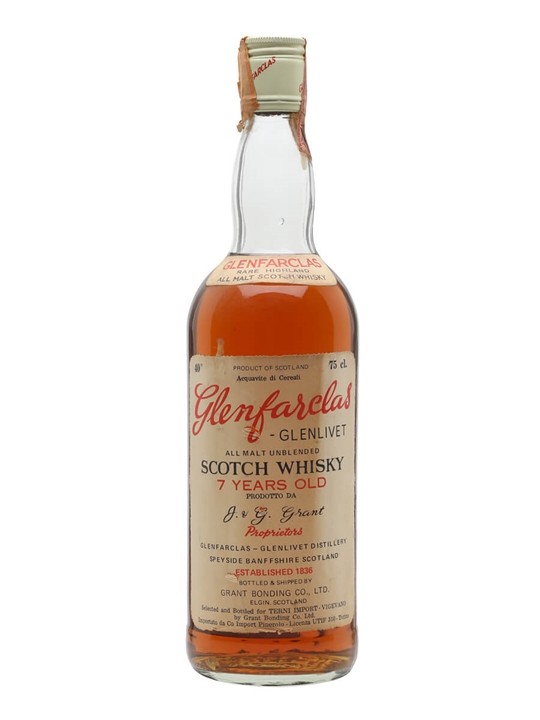

There are bottles you drink, and there are bottles you sit with. The Glenfarclas-Glenlivet 7 Year Old, bottled sometime in the 1970s, belongs firmly in the latter category. This is a whisky that speaks to a particular moment in Scotch history — when Speyside distilleries still carried hyphenated names as a nod to the region's most famous glen, and when seven years in cask was considered perfectly adequate for a serious dram. At 40% ABV and carrying a price tag of £350, this is less a bottle of whisky and more a small window into how Speyside expressed itself half a century ago.
The dual naming convention — Glenfarclas-Glenlivet — is worth pausing on. This was common practice through much of the twentieth century, when distilleries appended 'Glenlivet' to their own name as a mark of regional prestige. It tells you something about the era: Speyside wasn't yet the global brand it would become, and distilleries were still trading on geography rather than marketing departments. Holding a bottle like this, you're holding a piece of that older, less polished industry.
At seven years old, this is a young whisky by today's standards, but context matters. Distilling and maturation practices in the early 1970s were different beasts entirely. Cask selection, warehouse conditions, the spirit itself — all of these variables would have produced a profile distinct from what a modern seven-year-old Speyside might offer. The lower bottling strength of 40% suggests this was intended as an accessible, everyday Speyside — the kind of bottle that would have sat behind a bar or on a family sideboard without ceremony.
Tasting Notes
I won't fabricate specific notes where memory and honest assessment demand restraint. What I will say is this: a 1970s Speyside bottling at this age, from a distillery with Glenfarclas's reputation for sherry cask work, would typically sit in the orchard fruit and malt-forward territory. Expect the kind of approachable, clean Speyside character that made the region synonymous with single malt in the first place. The relatively young age statement means spirit character will be more prominent — and with a bottling from this period, that is no bad thing at all.
The Verdict
I'm giving this an 8 out of 10. That score reflects not just what's in the glass, but what this bottle represents. As a drinking whisky, it delivers honest Speyside character from an era when the category was still defined by craft rather than corporate strategy. As a collector's piece, it's a genuine artefact — the hyphenated label, the vintage glass, the understated presentation all speak to a time before whisky became a luxury commodity. At £350, you're paying for rarity and provenance rather than age, and I think that's a fair exchange. This is a bottle for someone who understands that the story matters as much as the liquid.
Best Served
Neat, and at room temperature. If you're fortunate enough to open one, pour it into a proper nosing glass — a Glencairn or a copita — and give it ten minutes to breathe. A few drops of water may open things up, but I'd taste it unadorned first. This is not a whisky for cocktails or casual mixing. It deserves your full attention, a comfortable chair, and perhaps the company of someone who'll appreciate what they're drinking.