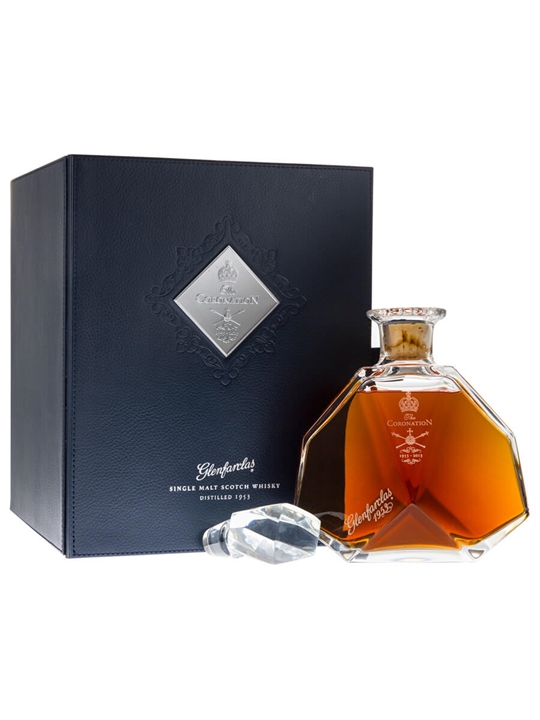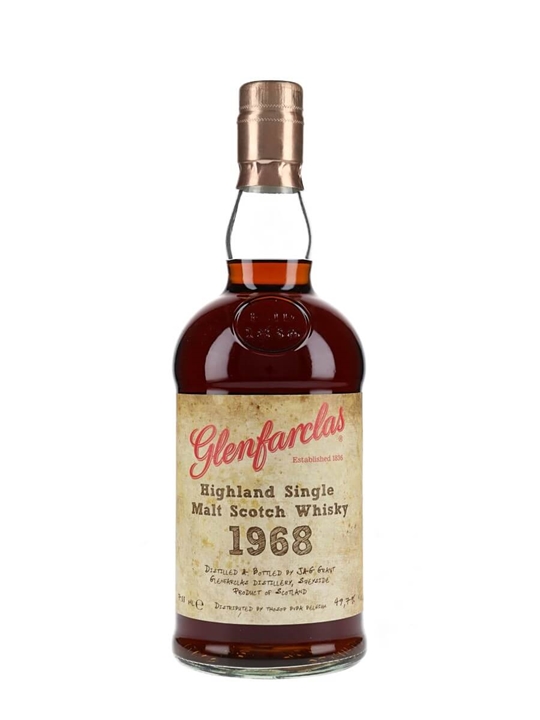

There are bottles that sit on a shelf, and then there are bottles that represent a moment frozen in time. The Glenfarclas 1968, drawn from sherry casks #702 and #5240 after forty-one years of patient maturation, belongs firmly in the latter category. Distilled in 1968 and bottled at a natural strength of 49.7% ABV, this is a whisky that has spent longer in wood than most of us have spent in our careers. At £4,000, it demands serious consideration — and having spent time with it, I believe it earns that consideration honestly.
A 41-year-old Speyside from sherry casks at near cask strength is, by any measure, a rare proposition. The fact that it has retained 49.7% ABV after four decades in oak tells you something immediately: these were well-chosen casks stored in favourable conditions. Lesser casks would have stripped the spirit bare or dropped the strength to something barely above minimum bottling proof. That this whisky still carries genuine weight at its age speaks to the quality of the wood and the care taken during its long sleep.
What you should expect from a whisky of this vintage and maturation profile is depth without excess. Forty-one years in sherry wood will have built layers of dried fruit character, old leather, polished oak, and the kind of waxy complexity that only extreme age can produce. The Speyside origin suggests an underlying elegance — a framework of orchard fruit and malt sweetness that, even after decades, should provide structure beneath all that sherry influence. This is not a whisky that shouts. It is a whisky that has had forty-one years to decide exactly what it wants to say.
Tasting Notes
With no formal tasting notes on record for this specific bottling, I would encourage anyone fortunate enough to acquire a bottle to approach it with patience. Give it time in the glass. A whisky of this age and strength will continue to evolve over twenty, thirty, even forty minutes of air contact. The 49.7% ABV means it can take a few drops of water without falling apart, and I suspect it will reward that generosity. The marriage of two specific cask numbers — #702 and #5240 — suggests a deliberate vatting to achieve a particular balance, which is worth respecting.
The Verdict
I am scoring this 8.4 out of 10. That is a strong mark, and I give it with confidence. The combination of genuine age, sherry cask maturation, robust natural strength, and Speyside provenance places this bottle in distinguished company. It loses a fraction only because at £4,000 you are inevitably paying a premium for rarity and collectibility alongside the liquid itself — and I always score the whisky, not the auction value. But make no mistake: this is a serious piece of whisky history. The 1968 vintage puts its distillation in an era when production methods, yeast strains, and barley varieties were meaningfully different from today. You are not just drinking old whisky — you are drinking a style of Speyside spirit that simply does not exist anymore.
Best Served
Neat, in a tulip glass, at room temperature. Nothing else. If after fifteen minutes you feel it needs opening up, add three or four drops of still water — no more. A whisky that has waited forty-one years deserves your full, undivided attention. This is not a dram for cocktails, nor for casual evenings. Choose a quiet moment, sit down, and give it the time it has earned.