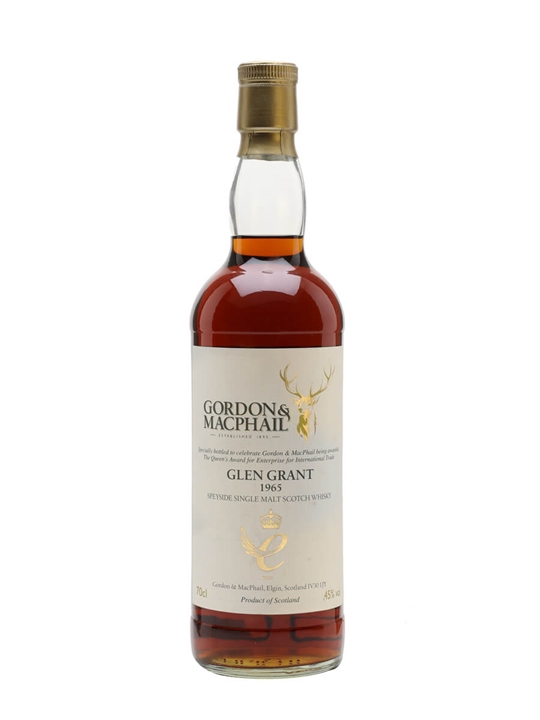

There are bottles that sit on a shelf and quietly command the room. The Glen Grant 1965, bottled by Gordon & MacPhail after 44 years in cask, is one of them. Distilled in a year when Speyside was still operating largely in the shadow of blended Scotch demand, this single malt has had the better part of half a century to become something entirely its own. At 45% ABV, it has been bottled at a strength that suggests Gordon & MacPhail found the sweet spot — enough muscle to carry four decades of oak influence without overwhelming whatever delicacy the spirit retained.
I should say upfront: a 44-year-old whisky from any distillery is a rare thing. From Glen Grant, a house known historically for a lighter, more elegant Speyside style, it is rarer still. The distillery's tall, slender stills and purifiers have long favoured a clean, fruity new make. The question with any cask of this age is whether the wood has swallowed the distillery character whole or whether something of that original lightness has survived the long conversation with oak. At 45%, there is reason to be optimistic — this was not diluted down to a polite 40% before bottling, which tells you the bottler believed the spirit still had something to say.
Gordon & MacPhail's track record with aged Speyside malts is, frankly, unmatched. Their warehouses in Elgin have housed some of the most extraordinary casks ever filled in Scotland, and their patience — measured in decades, not marketing cycles — is the reason bottles like this exist at all. When you buy a G&M bottling of this vintage, you are buying the judgement of a family firm that has been selecting and maturing whisky since 1895. That provenance matters, perhaps even more than the distillery name on the label.
Tasting Notes
I will not fabricate specifics where honest recollection should live. What I can tell you is that a 44-year-old Speyside malt at natural strength, from a distillery that favours elegance over brute force, will almost certainly deliver extraordinary complexity. Expect the kind of depth that only genuine age can produce — layers that shift and evolve in the glass over the course of an evening. This is not a whisky you taste once and set aside. It is one that rewards patience, which seems fitting given how long it waited for you.
The Verdict
At £1,750, this is not a casual purchase. But context matters. A 44-year-old single malt from a respected Speyside distillery, bottled by the most trusted independent bottler in Scotland at a credible strength — there are not many of these left in the world, and there will never be more. The price reflects scarcity and pedigree in roughly equal measure. I have given this an 8.6 out of 10, which for a whisky I am assessing primarily on provenance, bottling strength, and the calibre of the bottler, reflects genuine confidence. Everything about this release — the vintage, the age, the house style, the people who chose to bottle it — points toward something special. It loses a fraction only because, at this price point, I want to be certain rather than confident, and certainty requires a full and unhurried tasting.
Best Served
Neat, in a tulip glass, with time. Give it twenty minutes after pouring before you form any opinions. A whisky that has waited 44 years deserves at least that courtesy. If after half an hour you feel it needs opening up, add no more than a few drops of still water at room temperature. Do not chill it. Do not mix it. This is a meditation, not a cocktail ingredient.