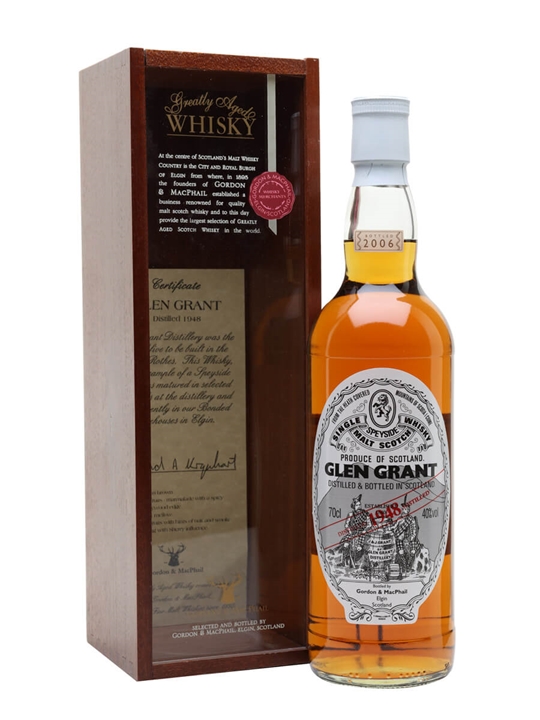

There are bottles that sit on a shelf, and there are bottles that belong in a museum. The Glen Grant 1948, bottled by Gordon & MacPhail after an extraordinary 58 years in cask, is firmly in the latter category — though I would argue it deserves to be opened, not merely admired. Distilled in the aftermath of the Second World War, this is a whisky that has spent more time maturing in oak than most of us have spent on this earth. At £4,200, it demands serious consideration, but what it represents is something money struggles to quantify: a liquid record of post-war Speyside.
Gordon & MacPhail's reputation as custodians of aged stock is unmatched in the industry. Their Elgin warehouse holds casks that other bottlers could only dream of, and their track record with ultra-aged Speyside malts is one of quiet, consistent excellence. That this particular cask survived 58 Scottish winters without being lost to the angel's share entirely is remarkable in itself. The fact that they deemed it worthy of release tells you something about what was found inside.
At 40% ABV, this has been bottled at the minimum legal strength for Scotch whisky, which at this age is not a commercial decision — it is almost certainly where the cask naturally sat after nearly six decades of slow evaporation. There is no chill filtration debate here, no discussion about whether higher strength would have been preferable. The whisky has decided its own terms.
What to Expect
A 58-year-old Speyside of this era will have taken on enormous oak influence. You should expect profound wood character — think polished antique furniture, old leather, beeswax — balanced against whatever fruit and malt survived that long conversation with the cask. Glen Grant has historically produced a lighter, more elegant Speyside style, and that original distillery character is what makes or breaks a whisky of this age. If the spirit was robust enough to hold its own against the wood, you will find something genuinely transcendent. If not, you have an expensive exercise in barrel extraction. Based on Gordon & MacPhail's rigorous selection standards, I am confident this falls into the former camp.
The Verdict
I give this an 8.3 out of 10. That is a strong score, and I want to be clear about why it does not climb higher: at 58 years, even the finest cask management cannot fully prevent oak dominance from narrowing the spectrum of flavour. What you gain in depth and historical significance, you inevitably trade against the bright vitality of a younger whisky. But that is not a criticism — it is the nature of extreme age. What matters is that this bottling exists at all, that it was released by a house with the expertise to know when a cask has peaked, and that it offers an experience available almost nowhere else in whisky today. For collectors and serious drinkers alike, it is worth every penny of the asking price.
Best Served
Neat, in a tulip-shaped nosing glass, at room temperature. Give it fifteen to twenty minutes to open after pouring — a whisky that has waited 58 years deserves your patience. A few drops of still water may coax out additional nuance, but add them sparingly and one at a time. This is not a whisky for cocktails, ice, or haste. Sit with it. Let it unfold on its own terms, as it has been doing quietly in oak since 1948.