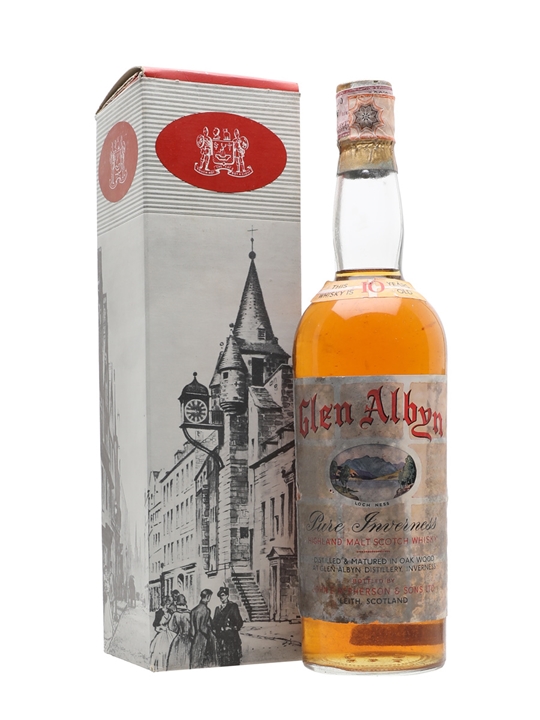

There are bottles that sit on a shelf and there are bottles that carry the weight of an entire lost distillery on their shoulders. Glen Albyn 10 Year Old, bottled at cask strength by Whiskyteca sometime in the 1970s, is firmly in the latter category. This is not a whisky you stumble across — it is one you hunt for, and when you find it, you understand immediately why collectors treat these bottles with something close to reverence.
Glen Albyn operated in Inverness from 1846 until its demolition in 1983, one of several Highland distilleries that fell victim to the industry contractions of that era. What remains are finite stocks, scattered across private collections and the occasional auction house. To hold a bottle from the 1970s is to hold a piece of Scotch whisky history that simply cannot be replicated. The distillery is gone. The stills are gone. Every bottle opened is one fewer in existence.
What to Expect
At 56.9% ABV, this is a serious dram — full cask strength with no concessions made to accessibility. A 10-year-old Highland malt bottled at this proof in the 1970s would have been matured in an era when cask selection was less clinical and more instinctive, which often produced results with remarkable character. The Whiskyteca bottling carries an independent reputation for careful cask selection during this period, and the fact that this was released at natural strength rather than diluted to a standard 40% or 43% tells you something about the confidence behind it. Someone tasted this cask and decided it deserved to speak for itself.
Highland malts of this vintage tend towards a profile that modern production has largely moved away from — less polished, more assertive, with a rawness that rewards patience. At ten years old, you are getting a whisky that has taken enough from the wood to develop complexity without losing its distillery character beneath layers of oak influence. The balance between spirit and cask at this age, particularly at full strength, can be exceptional when the underlying make is good.
The Verdict
I score this 8.1 out of 10, and I want to be clear about what that number represents. This is not a flawless, perfectly orchestrated single malt in the way a modern luxury release might aim to be. It is something more interesting than that. It is a genuine artefact from a distillery that no longer exists, bottled without compromise at cask strength during an era when independent bottlers were working with stock that today's market would consider priceless. The £2,500 price tag is significant, but within the context of closed distillery bottlings — particularly one from the 1970s at natural strength — it sits within a defensible range. You are paying for rarity and provenance as much as liquid, and both are beyond question here. For the collector or the serious Highland enthusiast, this is a bottle that justifies its place.
Best Served
Neat, at room temperature, in a tulip-shaped nosing glass. Give it ten minutes to open after pouring. If the cask strength feels imposing, add water sparingly — a few drops at a time, no more. A whisky like this has waited over fifty years to be tasted. There is no rush. Let it unfold on its own terms.