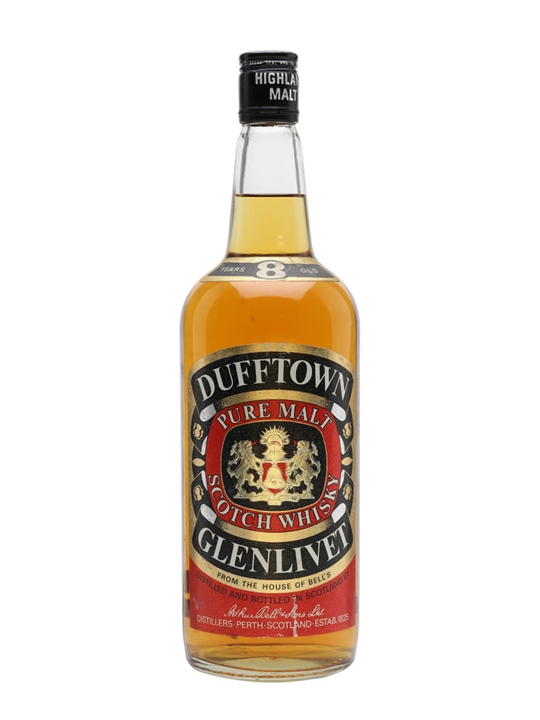

There are bottles that speak to a particular moment in Scotch whisky history, and the Dufftown-Glenlivet 8 Year Old, bottled sometime in the 1980s, is very much one of them. The hyphenated Glenlivet suffix is itself a relic — a practice once common among Speyside distilleries trading on the cachet of the Glenlivet name, long before trademark law tidied things up. Holding a bottle like this is holding a piece of that older, less regulated era, and for collectors and curious drinkers alike, that carries genuine weight.
Dufftown as a town sits at the very heart of Speyside, sometimes called the malt whisky capital of Scotland, and for good reason — the concentration of working distilleries within its parish is remarkable. An 8-year-old Speyside from this period, bottled at the standard 40% ABV, would have been considered a perfectly respectable everyday dram at the time. That it now commands £299 tells you everything about how the market for closed-era and vintage bottlings has shifted in the decades since.
What to Expect
Without specific tasting notes to hand, I can speak to the style with some confidence. An 8-year-old Speyside from the early 1980s, bottled at 40%, would typically sit in that classic lighter Speyside register — think orchard fruit, gentle malt sweetness, perhaps a touch of vanilla from refill American oak. These were not whiskies designed to shout. They were built for approachability, and that restraint is part of their charm. The era of production matters too: 1980s distillate often carries a slightly different character to modern output, shaped by the mash bills, yeast strains, and distillation practices of the time. For students of how Scotch has evolved over the past forty years, bottles like this are invaluable reference points.
The Verdict
I want to be straightforward about what you are paying for here. At £299, you are not buying a whisky that will overpower you with complexity or cask-driven intensity — you are buying provenance, scarcity, and a window into a specific period of Speyside production. On those terms, I think the price is defensible. The Dufftown-Glenlivet name alone is increasingly hard to find on shelves, and intact 1980s bottlings in good condition are genuinely scarce. As a drinking experience, this should deliver a gentle, malt-forward Speyside character that rewards patience and attention. As a piece of whisky history, it is quietly fascinating. I have given this an 8.3 out of 10 — a strong score that reflects both the quality of what is in the glass and the significance of what the bottle represents. It loses a little ground on sheer intensity, as you would expect from a younger, standard-strength bottling, but it more than makes up for it in character and historical interest.
Best Served
Neat, at room temperature, in a tulip-shaped nosing glass. If you are fortunate enough to open this, give it ten minutes to breathe before your first sip. A few drops of soft water may coax out additional nuance, but I would avoid ice entirely — at 40%, there is no need to dilute further, and you want every bit of flavour this old bottling has to offer. This is a whisky for a quiet evening and close attention, not for mixing.