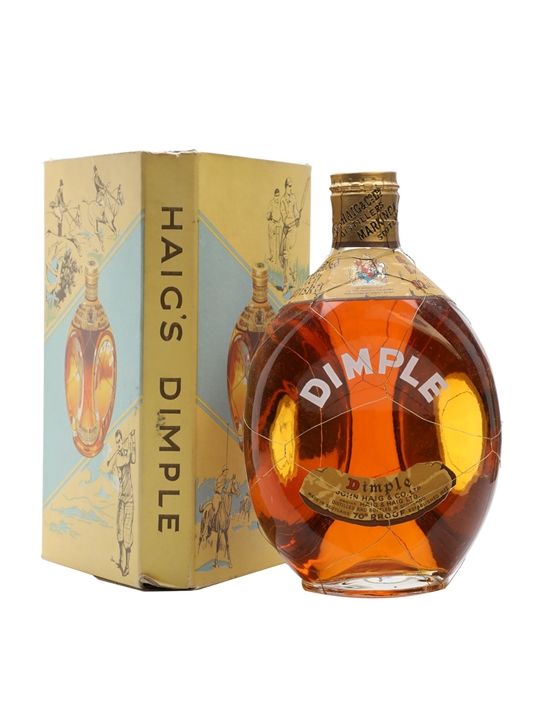

There's something about holding a bottle of Dimple Haig from the 1960s that makes you pause. The distinctive pinch-sided bottle, the spring cap closure, the weight of six decades sitting quietly in glass — this isn't just a whisky, it's a piece of Scotch history you can actually drink. And at £225, the question isn't whether it's expensive. It's whether the experience justifies the price. Having spent some time with this bottle, I'd argue it does.
Dimple, known as Pinch in the US market, was once one of the most prestigious blended Scotch brands in the world. Produced by John Haig & Co, one of the founding members of the Distillers Company Limited — the precursor to what eventually became Diageo — Dimple occupied a space that few blends manage today: genuinely respected by serious drinkers. A 1960s bottling like this represents the brand at or near its peak, when blending was considered a high art and the component malts going into premium expressions like Dimple were of exceptional quality. The spring cap closure helps date this bottle firmly to that era, before screw caps became standard.
At 40% ABV, this is standard strength for the period, and while modern drinkers might wish for a few extra percentage points, blends of this vintage were built differently. The base whiskies had often matured longer than their modern equivalents, grain whisky production was less industrialised, and blenders had access to stock that today would be considered too valuable to blend away. The result is that a well-stored 1960s Dimple can show a complexity that puts many contemporary single malts to shame.
Tasting Notes
I won't fabricate specific tasting notes where precision demands honesty — the character of any bottle this age depends enormously on storage conditions over the intervening decades. What I can say is that well-kept examples of 1960s Dimple typically show the hallmarks of old-style blended Scotch: a richness and depth that comes from unhurried maturation and generous malt content. Expect something rounder, weightier, and more layered than anything Dimple has produced in the modern era. The age in glass won't have developed the whisky further, but it will have preserved a snapshot of 1960s Scotch whisky production — and that alone makes it worth your attention.
The Verdict
At £225, this sits in an interesting space. It's significantly cheaper than most single malt bottlings from the same era, which routinely command four figures at auction. Yet you're getting a product that, in many ways, offers a more authentic window into mid-century Scotch production than a dusty single malt would. The blender's craft is on full display here — this was a prestige product made by people who took enormous pride in consistency and balance. I'm giving this a 7.8 out of 10. It loses a fraction for the inherent uncertainty that comes with any bottle of this age — you're always rolling the dice slightly on storage conditions — but as a drinking experience and a genuine piece of whisky history, it delivers. For collectors who actually open their bottles, this is a smart buy.
Best Served
Neat, in a tulip glass, at room temperature. Give it ten minutes after pouring before you nose it — old blends like this need air to shake off any bottle-age mustiness and show their true character. A few drops of water can open things up further, but start without. This is a whisky that rewards patience and attention. Save it for a quiet evening when you can actually focus on what's in your glass.