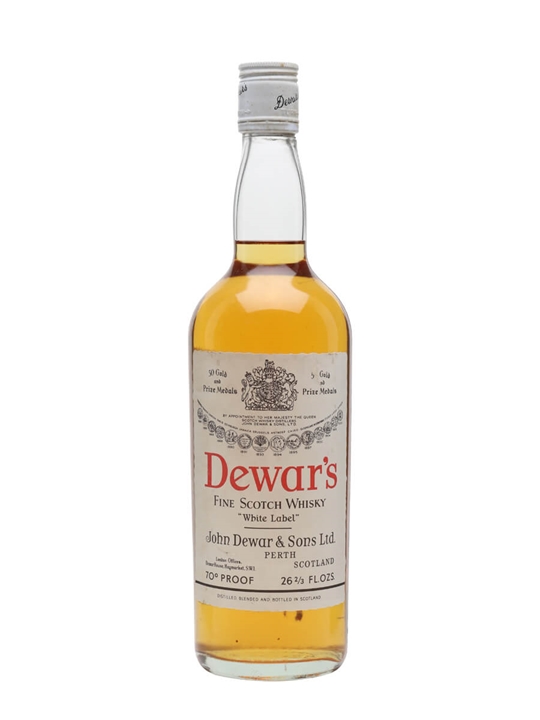

There's something genuinely thrilling about holding a bottle that's been sitting quietly for half a century. This 1970s bottling of Dewar's White Label isn't just a blended Scotch — it's a time capsule from an era when the whisky industry operated under entirely different rules. Different grain stocks, different malt components, different blending philosophies. At £150, you're not paying for what Dewar's White Label costs today on any supermarket shelf. You're paying for what it was then, and what five decades of gentle evolution inside glass have done to it.
For context, Dewar's in the 1970s was riding high. The brand was already over a century old, John Dewar & Sons had long established themselves as one of Scotland's premier blenders, and the component malts available to their blending team were drawn from a landscape that simply doesn't exist anymore. Closed distilleries, discontinued spirit styles, barley varieties that have since fallen out of commercial use — all of it potentially in the glass. That's what makes vintage blends so fascinating to me. They're archaeological as much as they are enjoyable.
At 40% ABV and with no age statement, this would have been positioned as an everyday pour in its day. The beautiful irony of vintage blended Scotch is that the entry-level expressions often tell you more about an era's baseline quality than any prestige bottling. This was the standard. This was what ordinary blending skill produced when nobody was watching too carefully or marketing too aggressively.
Tasting Notes
I won't fabricate specific notes I can't verify from the data at hand. What I can tell you is that 1970s blends of this calibre typically present a rounder, more malt-forward character than their modern equivalents. The grain whisky component from that period tended to carry more weight and texture. Expect a softer, more honeyed profile than anything you'd find in a current White Label — time in glass at this age often knocks the sharper edges off entirely, leaving something remarkably integrated. If you open this bottle, take your time with it. Let it breathe. It's earned that much.
The Verdict
I'm giving this a 7.9 out of 10, and here's my reasoning. As a drinking experience, a vintage blend like this is almost certainly going to over-deliver against what the label suggests. The name says everyday Scotch; the era and the age say something considerably more interesting. I'm docking it slightly because at £150, you're paying a collectors' premium — this is priced as a curiosity rather than pure liquid value, and I think buyers should go in with their eyes open about that. But for anyone with an interest in how Scotch whisky has changed over the past fifty years, or anyone who simply wants to taste what a competent 1970s blend actually delivered, this is well worth the money. It's a genuine piece of whisky history that you can actually drink, and that combination doesn't come along every day.
Best Served
Neat, at room temperature, in a proper nosing glass. This isn't a bottle for mixing or for ice. Give it fifteen minutes after pouring to let it open up — spirit this old can be shy at first. If you're feeling slightly adventurous, a few drops of water might coax out additional complexity, but start without. And for what it's worth, I'd suggest sharing it. A bottle like this is a conversation piece, and conversations about whisky are always better when there's something genuinely interesting in the glass.