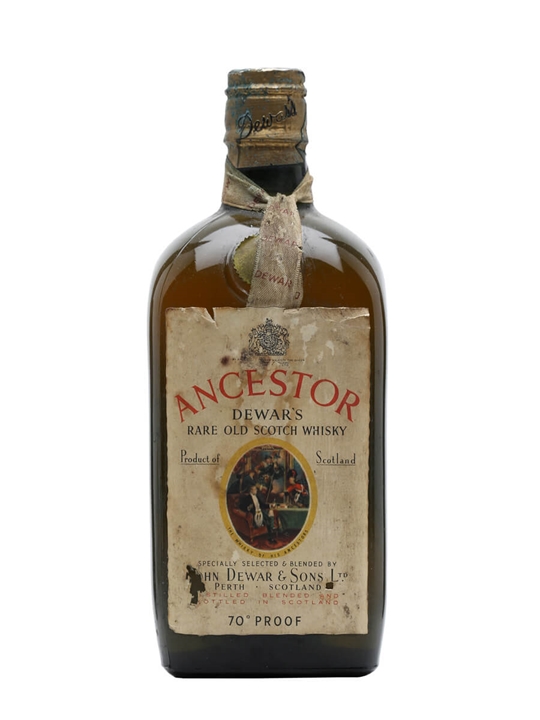

There's something about holding a bottle from the 1950s that recalibrates your relationship with whisky. The Dewar's Ancestor with its spring cap closure sits in your hand not as a drink but as an artifact — a snapshot of blended Scotch from an era when the category commanded genuine respect, before the vodka wars of the 1970s and the single malt snobbery that followed. At £399, you're paying for time travel as much as liquid, and I'd argue that's a fair transaction.
For context, Dewar's Ancestor was positioned as the premium expression in the Dewar's range during this period. The "Ancestor" name nodded to John Dewar himself, and the blend would have been composed from a selection of Highland and Speyside malts married with grain whisky — standard practice for a respected blended house, but the quality of components available to Dewar's blenders in the 1950s was frankly extraordinary. Stock was plentiful, aged inventory was deep, and the commercial pressure to cut corners hadn't yet arrived.
The spring cap is the tell here. That closure style dates this bottle confidently to the 1950s, and it also means the seal has likely held well over the decades. Proper storage matters enormously with vintage bottles, but spring caps tend to maintain integrity better than many collectors assume.
What to Expect
Blended Scotch from this era is a different animal to what you'll find on shelves today. The grain whisky component would have been distilled in older, less efficient column stills that produced heavier, more characterful spirit. The malt components were almost certainly dried over peat to varying degrees — not the aggressive medicinal peat of modern Islay marketing, but a gentle smokiness that was simply part of the production landscape. At 40% ABV, this was bottled at what was then the standard strength, and the decades of slow micro-oxidation in glass will have softened and integrated the blend further.
I'd expect something rounder, richer, and more texturally interesting than any modern Dewar's expression. Old blends at this level consistently surprise people who've written off the category. The complexity sits quietly — it doesn't announce itself the way a sherried single malt does, but it rewards patience.
The Verdict
An 8/10 feels right for this bottle. It's not the rarest vintage Scotch you'll find, and Dewar's, for all its heritage, doesn't carry the collector cachet of a 1950s Black Label or an old Ballantine's. But that's partly what I like about it. This is a bottle you can actually justify opening. The liquid inside represents a standard of blending that the industry has largely moved away from, and tasting it offers genuine insight into what Scotch whisky used to be — and arguably should still be. The price reflects the age and scarcity without entering the territory of pure speculation. For anyone curious about vintage blends, this is an honest and accessible entry point.
Best Served
Pour it neat into a tulip glass at room temperature and leave it for a good ten minutes. Vintage blends need air — they've been sealed for seventy-odd years, so give the spirit time to open up and stretch. If after twenty minutes you feel it needs a drop of water, add one, but I'd taste it untouched first. This isn't a cocktail ingredient. It's not a mixer. It's a piece of Scotch history at 40%, and it deserves your full attention and a comfortable chair.