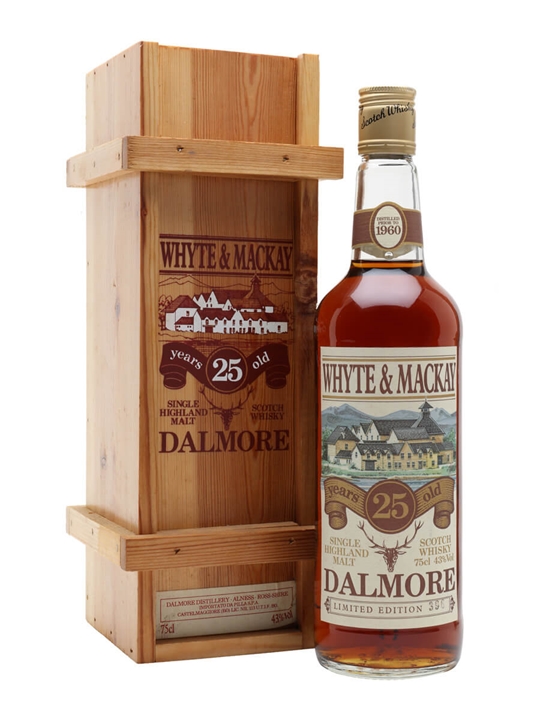

There are bottles that sit on a shelf and quietly announce their significance without a word needing to be spoken. The Dalmore 25 Year Old, distilled sometime before 1960 and bottled in the 1980s, is precisely that kind of whisky. This is not a dram you stumble upon — it finds you, usually at auction or through a collector who understands what they're parting with. At £5,000, it demands respect before you've even broken the seal.
What we have here is a Highland single malt from an era when distilling was a slower, less scrutinised craft. The spirit that went into cask would have been produced under conditions markedly different from today's tightly controlled environments — coal-fired stills, wooden washbacks seasoned by decades of use, and warehouse conditions dictated entirely by the Scottish climate rather than any algorithm. Twenty-five years of maturation through the 1960s and 1970s means this whisky absorbed the full character of that period's oak, likely a combination of European sherry casks and refill American oak, given Dalmore's long-established preference for sherry wood influence.
Bottled at 43%, this sits at a strength that was standard for its time — just above the legal minimum, yet sufficient to carry the weight of a quarter-century in wood. There is something honest about that. No cask strength theatrics, no special finishes layered on for marketing purposes. Just spirit, oak, and time.
What to Expect
A Dalmore of this vintage and age will have taken on a deep, burnished complexity. Highland distillates from the pre-1960 era tend toward a waxy, fuller-bodied character that modern production rarely replicates. With 25 years of cask influence, expect the kind of layered richness that only genuine old whisky delivers — dried fruits darkened almost to leather, polished wood, and that particular quality old Dalmore carries: a dense, almost savoury sweetness that distinguishes it from its Highland neighbours. The 43% ABV means it will be approachable, but I would not mistake approachability for simplicity. There is depth here that reveals itself slowly.
The Verdict
I score this 8.5 out of 10, and I do so with confidence. This is a piece of whisky history — a snapshot of Highland distilling from an era we cannot return to. The price is substantial, yes, but consider what you are actually buying: a spirit distilled over sixty years ago, matured for a quarter of a century, and bottled before many of today's whisky enthusiasts were born. It is not merely a drink but an artefact. Where it loses half a point is the uncertainty around provenance — without confirmed distillery attribution, there is a small question mark that prevents it from achieving a perfect collectible score. But as a drinking experience, as a connection to a bygone period of Scotch whisky production, it is genuinely remarkable.
Best Served
Neat, in a tulip-shaped nosing glass, at room temperature. Give it a full ten minutes to open after pouring. If you feel compelled, a single drop of water — no more — may coax out additional nuance, but I would taste it unadorned first. A whisky of this age and vintage has earned the right to speak for itself. This is not a Highball candidate. This is not a cocktail component. This is a dram you sit with quietly, preferably in good company, and allow to tell its story at its own pace.