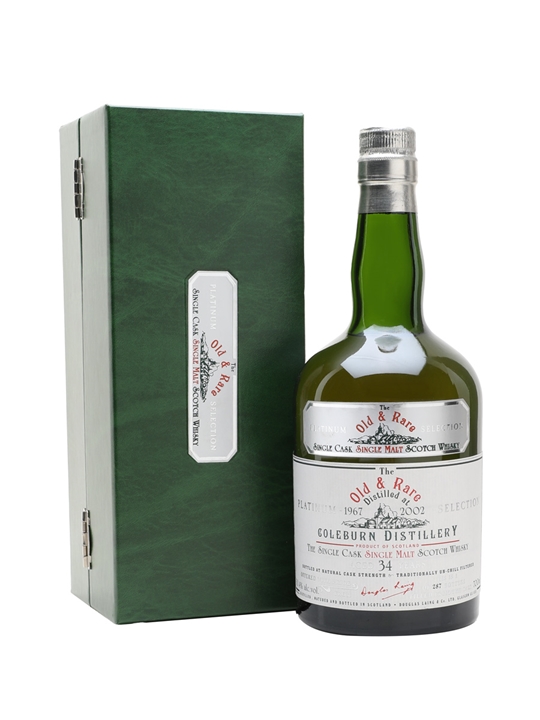

There are bottles that sit on the periphery of whisky history, quiet witnesses to an era that has long since closed its doors. Coleburn 1967, bottled at 34 years old by Douglas Laing, is precisely that kind of dram. The Coleburn distillery itself ceased production in 1985 and was never reopened — making every remaining cask a finite, irreplaceable piece of Speyside's story. To hold a bottle distilled in 1967 is to hold something that simply cannot be made again.
At 50.4% ABV, this is a natural strength bottling that has clearly been treated with the respect it deserves. Douglas Laing's reputation for selecting exceptional single casks is well established, and their decision to bottle at this strength rather than diluting down to 40% or 43% tells you something important: the cask had enough character and structural integrity after more than three decades to stand on its own terms. That is not a given with whisky of this age. Many distillates fall apart after prolonged maturation, becoming overly tannic or woody. A 34-year-old bottled at over 50% suggests a spirit that has aged with remarkable poise.
Coleburn was never a household name, even among enthusiasts. It operated primarily as a component malt for blends, which means the single malt releases are exceptionally scarce. The distillery's output was modest, and independent bottlings from the 1960s represent a vanishingly small pool of liquid. This scarcity is reflected in the price — at £1,000, this is not an everyday purchase, but for collectors and serious Speyside devotees, it represents access to a distillery that most people will never encounter in any form.
Tasting Notes
I will not fabricate specific tasting notes where my memory does not serve with precision. What I can say is this: Speyside malts of this vintage and age tend toward a particular profile — expect old oak influence balanced against whatever fruit character the spirit carried from its years in cask. At 50.4%, there should be genuine weight and presence on the palate. A whisky that has spent 34 years maturing has had a long, slow conversation with wood, and that dialogue will be evident in every sip.
The Verdict
I give this 8.3 out of 10, and I want to be clear about why. This is not a score based purely on liquid quality in the abstract — it is a score that reflects what this bottle represents. You are drinking the output of a dead distillery, from a cask filled during a period when Scotch whisky production methods were markedly different from today. The heavy, coal-fired stills, the less controlled fermentation, the different barley varieties — all of these contribute to a spirit with a character that modern distilleries simply do not replicate. The slight reservation in my score accounts for the price point, which places this firmly in collector territory and beyond the reach of most drinkers. But if you have the means and the inclination, this is a genuine piece of Speyside heritage in a glass.
Best Served
Neat, in a tulip-shaped nosing glass, at room temperature. If you have spent £1,000 on a 34-year-old whisky from a closed distillery, you owe it to yourself — and to the liquid — to experience it without interference. After your first few sips, a single drop of water may open things up further, but start without. Give it time. A whisky that has waited 34 years in oak deserves at least twenty minutes of your patience in the glass.