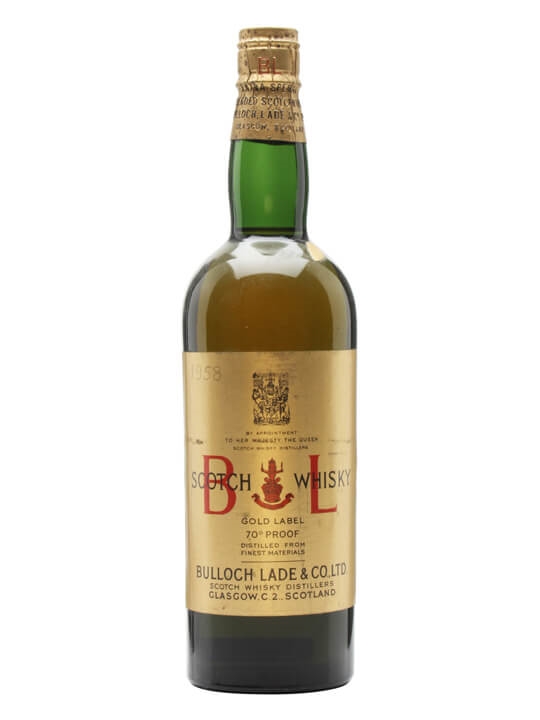

There are bottles you buy to drink, and there are bottles you buy because they represent something. Bulloch Lade's Gold Label, bottled sometime in the 1950s with its original spring cap intact, falls firmly into the second category — though I'd argue it still has plenty to offer anyone brave enough to crack the seal.
Bulloch Lade is a name that doesn't get nearly enough airtime in whisky circles today. The firm was once a serious player in the blended Scotch trade, operating out of Glasgow with ties to Caol Ila on Islay among other distilleries. By the mid-twentieth century, their Gold Label was a recognised blend on the domestic market. This particular bottle, with its distinctive spring cap closure, dates it to the 1950s — a period when blended Scotch was the undisputed king of the spirits world and single malts were something distillers sold to each other, not to the public.
What to Expect
At 40% ABV, this is a standard-strength blend of its era. What makes it interesting isn't the spec sheet — it's the context. Blended Scotch from the 1950s was made with component malts and grains that no longer exist in quite the same form. Distillation practices, barley varieties, cask sourcing — all of it was different. The flavour profiles of mid-century blends tend to carry a richness and a certain waxy character that modern blends, for all their technical precision, rarely replicate. You're tasting history in a very literal sense.
I won't fabricate specific tasting notes for a bottle of this age and rarity — conditions of storage, fill level, and the simple passage of seven decades all play their part. What I will say is that well-kept examples of 1950s blended Scotch consistently surprise people who assume "blended" means "lesser." These were serious whiskies made by serious blenders who had access to extraordinary casks.
The Verdict
At £450, you're paying for provenance, scarcity, and a genuine piece of Scotch whisky history. Is it expensive? For a bottle of blended whisky, undeniably. But compare it to what single malts of the same vintage fetch at auction — often well into four figures — and the Gold Label starts to look like one of the more accessible routes into mid-century Scotch. The spring cap closure is a lovely detail that collectors value, and it's a reliable indicator of the bottling period.
I'm giving this a 7.8 out of 10. It loses a touch for the inherent uncertainty that comes with any bottle this old — you simply cannot guarantee the condition of the liquid until you open it. But the pedigree of Bulloch Lade, the era of production, and the sheer novelty of tasting something bottled when rationing was a recent memory all push it firmly into recommendation territory. If you find one in good condition with a decent fill level, it's worth the investment — whether you intend to open it or simply admire it on the shelf.
Best Served
If you do open it, treat it with the respect it deserves. A small pour — no more than 25ml — in a tulip-shaped glass at room temperature. A few drops of still water if you like, but no ice, no mixers. This isn't a bottle you rush. Give it fifteen minutes in the glass before you even nose it. And for heaven's sake, have a notebook handy. You don't get to taste the 1950s every day.