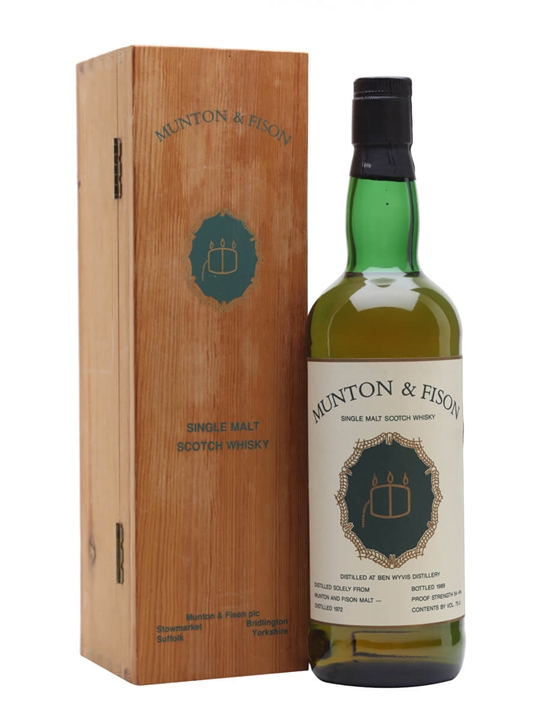

There are bottles that sit on the periphery of Scotch whisky history, and then there are bottles that belong to chapters most drinkers will never read. The Ben Wyvis 1972, bottled in 1989 by Munton & Fison, is firmly in the latter category. Ben Wyvis is one of Scotland's lost distilleries — a facility that operated for a painfully brief window within the Invergordon complex in Ross-shire, producing malt whisky from 1965 until its closure in 1977. Fewer than a handful of independent bottlings have surfaced over the decades, making any authenticated release a genuine piece of Highland whisky archaeology.
What we have here is a whisky distilled in 1972 and given seventeen years in cask before Munton & Fison, a name better known in the malting industry than the bottling trade, saw fit to release it at a robust 54.4% ABV. That cask strength bottling is significant — it tells us this was never intended to be softened or made approachable for a casual market. This was whisky bottled with confidence in what the liquid had become.
What to Expect
Without widely documented tasting notes for this specific bottling, I want to be honest about what a whisky of this provenance and era typically delivers. A 1972 Highland malt given nearly two decades of maturation at this strength suggests a spirit of considerable weight and complexity. The Invergordon site was not known for producing delicate whisky — the malt from Ben Wyvis was crafted to serve blending purposes, which generally means a spirit with backbone, cereal depth, and enough character to stand up in a crowd. At 54.4%, expect that character to arrive without apology.
The seventeen-year maturation would have introduced oak influence, but the high bottling strength indicates the cask did not dominate the spirit. This is likely a whisky where distillery character still speaks clearly, which is precisely what makes it valuable — you are tasting a distillery that no longer exists, not just the wood it sat in.
The Verdict
I'm giving this an 8.1 out of 10, and I want to be clear about why. This is not a score driven purely by rarity, though rarity is undeniably part of the conversation at £3,500. The score reflects what this bottle represents: an authentic cask-strength expression from a distillery that produced whisky for barely twelve years. The decision by Munton & Fison to bottle at natural strength rather than diluting to a standard 40% or 43% shows respect for the liquid, and that philosophy aligns with what serious collectors and drinkers want from a lost distillery bottling. It is a whisky that rewards patience and attention. It is not, however, a bottle I would call flawless — the limited information on its cask type and the relatively obscure bottler mean you are placing a degree of trust in provenance and condition. For the collector who has done that due diligence, this is a remarkable piece of Scottish whisky history in liquid form.
Best Served
Neat, in a tulip-shaped nosing glass, at room temperature. If you have spent £3,500 on a bottle of whisky from a dead distillery, you owe it to yourself and the spirit to experience it without interference. After fifteen minutes of breathing, add no more than three or four drops of still water to open the structure at that 54.4% strength. A whisky like this is not a casual pour — it is a conversation, and you should give it the silence it deserves.