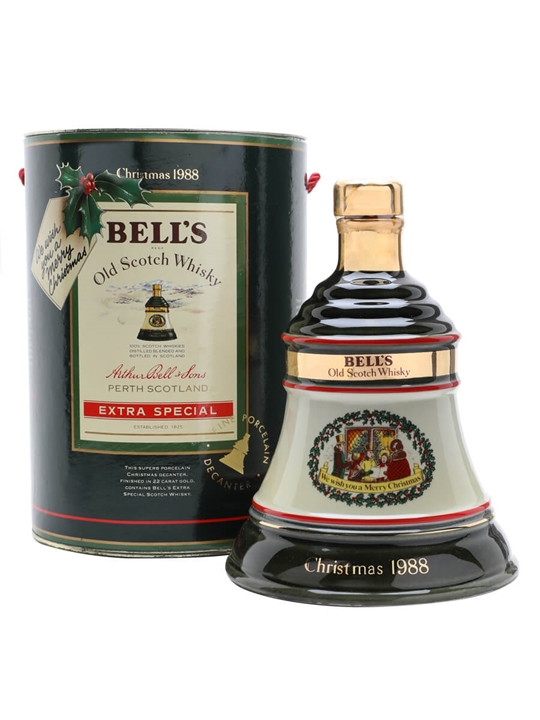

Bell's Christmas 1988. If you're of a certain vintage yourself, that phrase alone probably triggers a memory — a decanter-shaped bottle sitting on a sideboard, possibly still in its box, gifted by someone who understood that whisky and midwinter belong together. Arthur Bell & Sons had been producing these annual Christmas decanters since the early 1980s, and by 1988 the tradition was firmly cemented in the consciousness of British whisky drinkers. This isn't just a bottle of blended Scotch. It's a time capsule.
What we have here is an 8 Year Old blended Scotch, bottled at 43% ABV — a touch above the standard 40% that was already becoming the industry norm by the late '80s. That extra strength matters. It tells you something about how Bell's positioned these Christmas editions: a notch above the everyday pour, something worth wrapping in tissue paper. Bell's, of course, was built on the backbone of Blair Athol and Dufftown single malts, blended with a range of grain whiskies. The 8 Year Old age statement means every component in this blend has had at least eight years in oak, which for a blended Scotch of this era represents genuine commitment to quality over volume.
Context is everything with a bottle like this. In 1988, Bell's was the best-selling whisky brand in the UK — not the world, not Scotland, but specifically in the nation that arguably understood blended Scotch better than anyone. Guinness (which would eventually fold into Diageo) had acquired the brand, and these Christmas decanters were both a celebration and a marketing masterstroke. They turned a utilitarian spirit into a collectible. Nearly four decades later, at £250, you're paying for that history as much as for the liquid.
Tasting Notes
I won't pretend to break this down into granular note-by-note analysis — what I will say is that blended Scotch of this age and era tends to carry a particular character. The 8 year age statement at 43% ABV suggests a blend with genuine weight and presence. Bell's house style has always leaned towards malty warmth with a gentle spice, and the extra time in wood should bring a rounded, settled quality that younger blends simply cannot replicate. This is old-school Scotch blending, made before the accountants started shaving age statements and trimming ABV to protect margins.
The Verdict
Is this worth £250? That depends entirely on what you're buying it for. As a daily drinker, absolutely not — you can find excellent modern blends for a fraction of that. But as a piece of whisky history, a conversation starter, or a genuine collector's item from the peak of Bell's cultural dominance in the UK market, the price starts to make more sense. The 1988 Christmas decanter is one of the more sought-after editions, and finding one with the seal intact and liquid in good condition is increasingly difficult. I'd rate this an 8 out of 10 — not because it will outperform a modern craft blend in a blind tasting, but because it delivers something those bottles cannot: provenance, nostalgia, and a snapshot of an era when blended Scotch was king in Britain. It's a whisky that rewards you for knowing its story.
Best Served
If you do decide to crack the seal — and I'd understand the hesitation — pour it neat in a tulip glass at room temperature. Give it ten minutes to breathe. A blend this old deserves patience. A few drops of water if the ABV feels assertive, but no ice. This isn't a cocktail component. It's a sit-down, Sunday-evening, fire-on kind of dram. Pair it with a square of dark chocolate or a slice of Christmas cake if you want the full nostalgic experience.