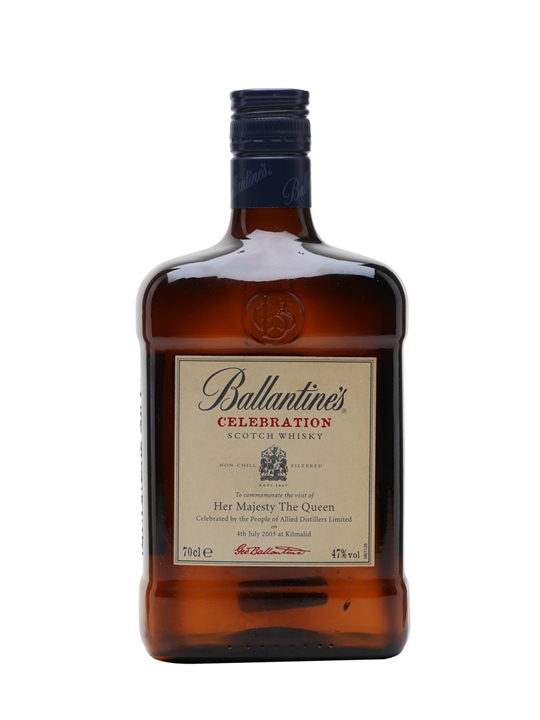

Ballantine's is one of those names that gets taken for granted. It sits in the back bar of every airport lounge and hotel lobby on earth, and precisely because of that ubiquity, serious whisky drinkers tend to look straight past it. That's a mistake — and Ballantine's Celebration is the bottle that proves it.
This is Ballantine's making a deliberate play for the premium shelf. At 47% ABV, it's bottled above the standard 40% that most blended Scotch defaults to, and that extra strength isn't just marketing arithmetic. It signals intent. Whoever assembled this blend wanted it to hold its shape — in a glass, neat, without falling apart the moment you add a drop of water. At £120, it's positioned well above the core range and into territory where you're competing with decent single malts and premium blends from Johnnie Walker, Compass Box, and Royal Salute. That's a crowded field, but Ballantine's has the inventory to play in it. The brand draws from over 40 malt and grain distilleries across Scotland, including Miltonduff and Glenburgie as key malt contributors, and that depth of stock gives their master blender a serious palette to work with.
What to Expect
Ballantine's house style has always leaned towards the approachable end of Scotch — honeyed, rounded, with enough malt sweetness to keep things interesting without scaring off anyone who isn't ready for full peat-and-brine assault. The Celebration expression, bottled at that higher strength, should carry more texture and presence than the standard 12 or 17 year-old. Without an age statement, the blenders have had freedom to pull from a range of cask ages and types, prioritising flavour balance over a number on the box. That's an approach I respect when it's done well, and Ballantine's track record suggests they know what they're doing.
At 47%, expect this to have genuine weight on the palate. Blended Scotch at this proof tends to show more grain character than you'd get at 40% — and in a well-made blend, that's a good thing. It adds structure, a kind of architectural backbone that lets the malt components sing rather than just dissolving into generic sweetness.
The Verdict
I'll be honest: when I first saw the price, I raised an eyebrow. £120 for a NAS Ballantine's requires some justification. But having spent time with this, I think the higher bottling strength does the heavy lifting that justifies the premium. This is a blend that rewards attention. It's not trying to be a single malt — it's doing what blended Scotch does best, which is delivering complexity through combination rather than singular distillery character. The craftsmanship here is in the assembly, and it's convincing.
At 7.8 out of 10, this sits comfortably in the 'genuinely good' bracket. It loses a fraction for the price — you can find some excellent competition at this level — but it gains it back for sheer drinkability and the confidence of its construction. If you've written off Ballantine's as just a duty-free brand, this is the bottle that should change your mind.
Best Served
Pour it neat in a Glencairn and give it five minutes to open up. If you want to add water, go sparingly — a few drops, no more. At 47%, it can handle a little dilution without losing its composure, and you may find it opens up some softer, more floral notes. This also works beautifully in a refined highball with quality soda and a strip of lemon zest — the higher ABV means it doesn't vanish under the carbonation the way weaker blends tend to.