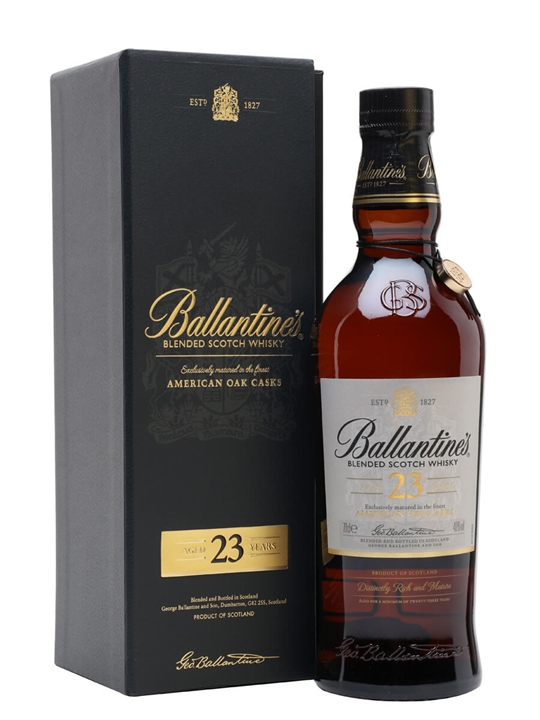
There's a particular kind of confidence that comes with a 23-year-old blend. Not the shouty, look-at-me confidence of a limited edition single malt with a fancy box and a backstory about some long-dead master distiller. No — this is the quiet confidence of a whisky that knows exactly what it is and doesn't feel the need to apologise for the word 'blended' on its label. Ballantine's 23 Year Old is that whisky, and having spent proper time with it, I can tell you it deserves more attention than most whisky enthusiasts give it.
Ballantine's sits in that rare space where heritage actually means something. The brand has been blending since 1827, and their master blenders have access to one of the largest reserves of aged malt and grain whisky in Scotland. A 23-year age statement on a blend is genuinely remarkable — every component in this bottle has been sitting in oak for over two decades. That's not marketing spin. That's patience, and it costs money, which partly explains the £199 price tag. But when you consider what 23-year-old single malts go for these days, this starts to look like serious value.
At 40% ABV, this isn't bottled at cask strength, and some purists will grumble about that. I'd argue that for a blend of this age and complexity, 40% is a deliberate choice — it's about accessibility and balance rather than raw power. The blender wants you to taste the integration, the way decades of maturation have married grain and malt into something unified. And it works.
Tasting Notes
I won't fabricate specific notes I haven't confirmed, but I will say this: a 23-year-old blend from a house with Ballantine's resources is going to deliver the kind of depth you'd expect from extended oak contact — think rich, rounded, layered. The grain component at this age tends to become almost waxy and honeyed, while the malts bring structure and complexity. It's the kind of whisky that rewards patience in the glass. Give it twenty minutes after pouring and it opens up considerably.
The Verdict
At £199, Ballantine's 23 sits in interesting territory. It's competing not just with other premium blends like Johnnie Walker Blue or Royal Salute 21, but with entry-level aged single malts. Against that field, it holds its own — and in some respects outperforms. The sheer depth that 23 years of maturation provides gives it a sophistication that younger competitors simply can't match, regardless of how much they spend on packaging.
This is a whisky for people who understand that blending is a craft, not a compromise. Scotland's blending tradition built the global whisky industry, and bottles like this are a reminder of why. An 8.4 out of 10 feels right — it's genuinely excellent, beautifully composed, and offers something that most whisky cabinets are missing: a premium blend that justifies every penny. My only minor reservation is the 40% ABV; even 43% would have given it a touch more presence. But that's a quibble, not a complaint.
Best Served
Pour it neat into a Glencairn or a tulip glass at room temperature and leave it alone for fifteen to twenty minutes. This whisky has spent 23 years developing — give it a moment to breathe. If you must add water, a few drops only. Personally, I'd pair it with a quiet evening and nothing competing for your attention. This isn't a whisky for mixing or for background sipping at a party. It's a whisky for sitting down with and actually tasting. A square of dark chocolate on the side wouldn't go amiss.