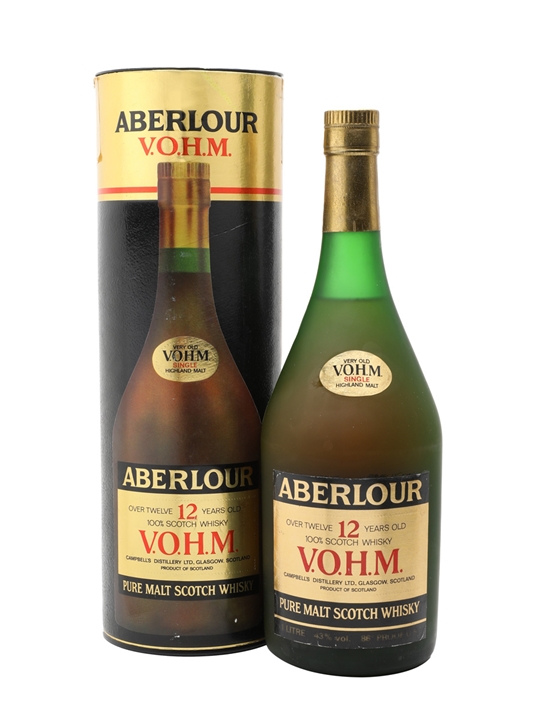

There are certain bottles that stop you mid-reach on a shelf — not because of flashy packaging or marketing bluster, but because they represent something quietly significant. The Aberlour 12 Year Old VOHM, bottled in the 1980s, is precisely that kind of whisky. VOHM — Very Old Highland Malt — was a designation Aberlour used during an era when Speyside distillers were less concerned with brand reinvention and more focused on letting the liquid do the talking. At £250, you are not simply buying a 12-year-old Speyside; you are buying a window into how this category tasted before the modern age reshaped it.
Aberlour has long been one of Speyside's most dependable names, and during the 1980s the distillery was producing whisky with a character that many collectors and serious drinkers consider distinct from its contemporary output. At 43% ABV, this sits at a strength that was standard for the period — marginally above today's common 40% — and that small difference matters. It suggests a bottling philosophy that prioritised integrity over cost-cutting, a detail that speaks volumes about the era's approach to single malt.
What should you expect from a 1980s Aberlour 12? Speyside of this vintage and age profile tends to deliver a generous, malt-forward style. The VOHM designation points toward a whisky that was positioned as a premium expression in its day, intended for drinkers who appreciated depth over simplicity. Twelve years in cask during this period typically meant interaction with wood that had seen fewer previous fills — a factor that often contributed richer, more expressive results than equivalent age statements produced today.
Tasting Notes
As this is a vintage bottling and individual bottle condition can vary, I have chosen not to publish specific tasting notes. Storage history, fill level, and closure integrity all influence how a whisky of this age presents in the glass. What I will say is that well-stored examples from this era of Aberlour production are consistently rewarding — the hallmarks of classic Speyside are present, and the passage of time in bottle tends to add a layer of complexity that younger stock simply cannot replicate.
The Verdict
I score this 8.2 out of 10, and I do so with genuine enthusiasm. This is not a bottle you buy for casual evening pours. It is a piece of Speyside history at a price point that, while significant, remains fair for a well-preserved 1980s single malt. The collector market has pushed comparable bottles from other distilleries well beyond this figure. For anyone with an interest in how Aberlour expressed itself before the modern era of sherry cask finishes and limited edition packaging took hold, this is a compelling purchase. It earns its score through provenance, period-correct bottling strength, and the simple fact that whisky from this decade of Speyside production is increasingly difficult to find in good condition.
Best Served
Neat, in a tulip-shaped nosing glass, at room temperature. If you have secured a bottle in good condition, give it ten minutes to open after pouring — vintage bottlings often reveal themselves gradually. A few drops of still water may coax out additional nuance, but I would taste it unadorned first. This is not a whisky that needs ice or a mixer. It has waited forty years for your attention; the least you can do is meet it on its own terms.