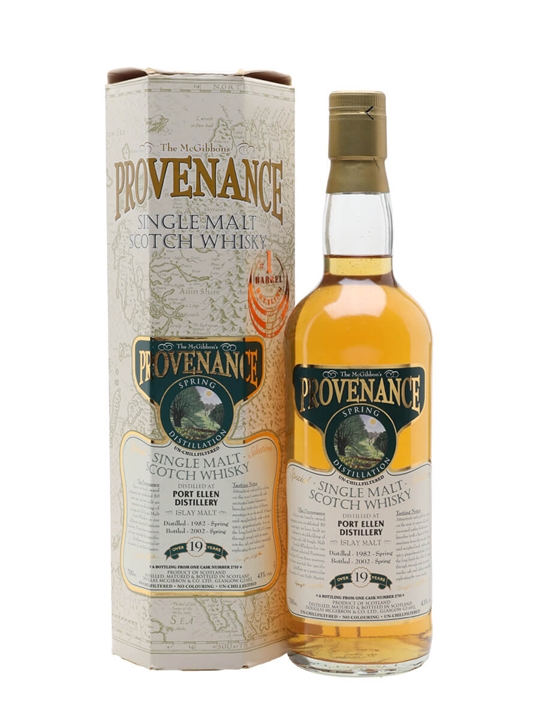

There are bottles you drink and bottles you sit with. Port Ellen 1982, drawn from cask #2733 after nineteen years of quiet patience, belongs firmly in the second camp. The distillery closed its doors in 1983, just a year after this spirit was laid down, which means every remaining cask is a dispatch from a world that no longer exists. Holding a glass of this feels less like tasting whisky and more like reading a letter from Islay's past.
I should be upfront: a thousand pounds is serious money for a bottle of anything. But Port Ellen isn't just any distillery. It's the ghost that haunts every serious Scotch conversation — the one that got away, the silent stills, the dwindling stock that gets rarer and more mythologised with each passing year. This particular bottling, released under the Provenance label, is an independent cask selection, which means it followed its own path rather than the official Diageo releases that now command auction-house prices well beyond this. In that context, a grand starts to look almost reasonable.
At 43%, this sits at a gentle, approachable strength — no cask strength fireworks here, just a whisky that's been allowed to settle into itself over nearly two decades. That's a deliberate choice by the bottler, and I think it's the right one. Nineteen years in oak at natural strength gives the spirit room to breathe without overwhelming the coastal character that made Port Ellen famous in the first place. This is Islay whisky from an era before peat levels became an arms race, when the smoke was a supporting player rather than the whole show.
Tasting Notes
I won't fabricate specific notes I can't verify from the data at hand. What I can tell you is that Port Ellen from this era — early 1980s distillation, long maturation — is known for a style that balances maritime salinity with a restrained, elegant smokiness. The Provenance series tends toward minimal intervention, letting the cask and the spirit do the talking. At nineteen years old, expect oak influence that's present but not domineering, with the kind of complexity that rewards patience in the glass.
The Verdict
I'm giving this an 8.1 out of 10, and here's why it isn't higher despite the pedigree: provenance alone doesn't make a perfect whisky, and at 43% from an unconfirmed cask type, there's a ceiling on how much intensity and complexity can survive. But what earns that strong score is rarity married to genuine quality. This isn't a bottle trading on name alone — it's a nineteen-year-old Islay single malt from one of the most celebrated distilleries ever to operate, bottled at a strength that prioritises drinkability over spectacle. For collectors and serious drinkers alike, it delivers something no operational distillery can: a taste of the finished article, the closed chapter, the last word.
Best Served
Neat, in a tulip glass, with nothing but time. Add a few drops of cool water if you like — at 43% it won't fall apart — but don't chill it, don't rush it, and for the love of all that's holy, don't mix it. Pour it on a quiet evening when the rain's doing its thing outside, let it open for ten minutes, and pay attention. Bottles like this don't come around twice.