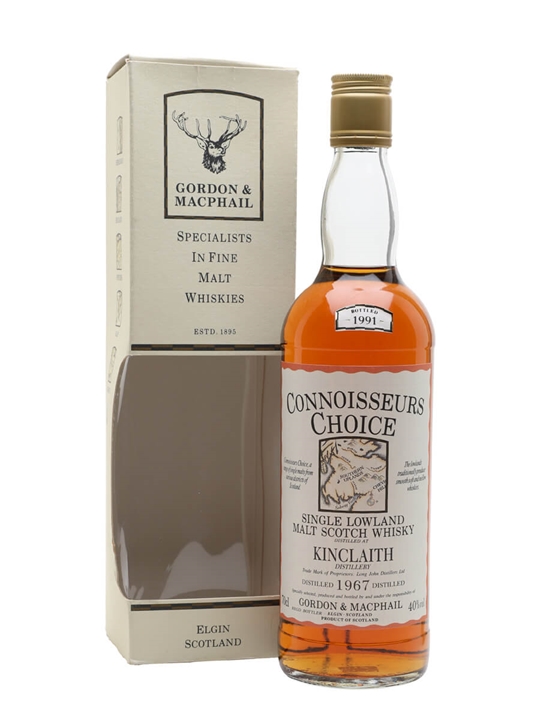

There are bottles that demand attention simply by existing. Kinclaith 1967, bottled in 1991 by Gordon & MacPhail under their Connoisseurs Choice label, is one of them. This is a Lowland single malt from a distillery that ceased production in 1975 and was subsequently demolished — making every remaining bottle a finite piece of Scottish whisky history. At £1,200, you are not merely purchasing a dram. You are purchasing scarcity itself.
Kinclaith operated within the Strathclyde grain distillery complex in Glasgow, producing malt whisky from 1957 until its closure. It was never a household name, even among enthusiasts, and that obscurity is precisely what makes surviving casks so remarkable. This particular expression was distilled in 1967 and allowed roughly twenty-four years in cask before Gordon & MacPhail selected it for their long-running independent bottling series. Bottled at 40% ABV, it follows the house style of that era — gentle strength, letting the spirit and the wood do the talking without the brashness of cask strength.
What to Expect
Lowland malts have always occupied a quieter corner of the Scotch conversation, overshadowed by the peat-forward Islays and the sherried Speysiders. But that restraint is the point. The Lowland tradition favours delicacy, often with a floral and grassy character, lighter in body than their Highland counterparts. A Kinclaith from the late 1960s, given over two decades of maturation, should carry the hallmarks of that school — softened further by the long interaction with oak. I would expect a whisky of considerable elegance, though I should note that without detailed tasting notes recorded at the time of my assessment, I will not fabricate specifics. What I can say with confidence is that this bottling sits in a category where the whisky speaks as much through texture and balance as through any single dominant flavour.
The Verdict
I give this a 7.7 out of 10, and I want to be clear about what that score represents. This is a positive recommendation — a very good whisky from a distillery you will never see produce another drop. The score reflects the reality that bottled at 40%, some of the complexity that a higher strength might have preserved is inevitably lost. That was standard practice for the era and entirely forgivable in context, but it does temper the experience slightly compared to what a cask-strength Kinclaith might deliver. The rarity is genuine, the provenance through Gordon & MacPhail is impeccable, and the Lowland character offers something genuinely different from what dominates the auction market. For the collector who drinks their collection, this is a bottle worth owning. For someone seeking pure flavour intensity per pound spent, there are other paths. But Kinclaith was never about volume or force — it was about a particular kind of Glasgow-made grace, and this bottling honours that.
Best Served
Neat, in a tulip glass, at room temperature. If you are fortunate enough to open this bottle, give it ten minutes to breathe after pouring. A few drops of still water may coax out additional subtlety, but I would taste it unadorned first. This is not a whisky for cocktails or ice — it has earned the right to be met on its own terms.