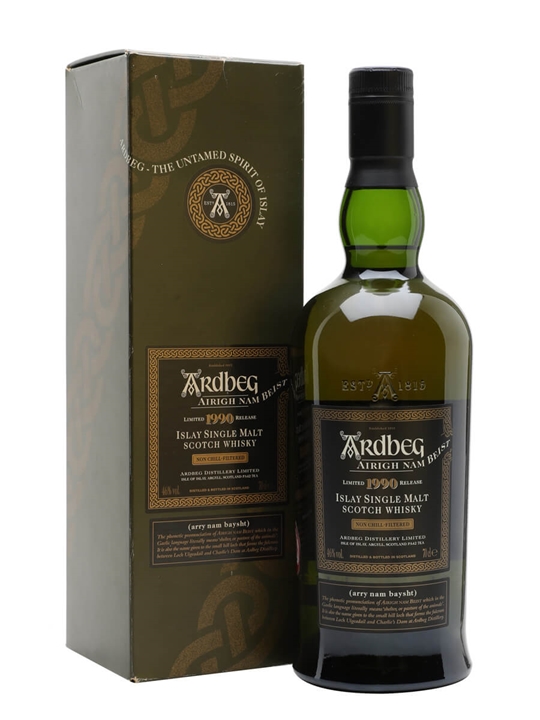

There are bottles you drink, and there are bottles that carry weather inside them. The Ardbeg 1990 Airigh Nam Beist, bottled in 2007, belongs firmly in the second category. Its very name — Airigh Nam Beist, the shelter of the beast — speaks to the wild southern coastline of Islay where the wind doesn't so much blow as argue with the landscape. I've stood on that shore more than once, jacket useless, tasting salt on my lips before I'd even uncorked anything. This whisky remembers those days too.
Distilled in 1990 and bottled seventeen years later at a natural 46% without chill-filtration, this sits in the era before Ardbeg's revival became a global phenomenon. The Airigh Nam Beist was a cult bottling even in its own time — a bridge between the old, sometimes erratic Ardbeg of near-closure years and the polished powerhouse it would become. To hold a bottle now, at £500, is to hold a piece of Islay's recent history, one that collectors and drinkers have been quietly hoarding for the better part of two decades.
What to Expect
This is Islay whisky of the old school. At 46% and non-chill-filtered, expect the full theatre: coastal peat, medicinal weight, and that particular Ardbeg character that sits somewhere between a bonfire on a beach and an apothecary's back room. The seventeen years of maturation should have softened the edges without filing them down entirely — this isn't a whisky that apologises for what it is. The 1990 distillation puts it in a period when Ardbeg's output was limited and, frankly, uneven, but the best casks from that era have a depth and individuality that the modern operation, for all its brilliance, rarely replicates. You're drinking scarcity as much as spirit.
The Verdict
At £500, this is not an everyday purchase. But it isn't priced for the everyday — it's priced for what it represents. A discontinued expression from a distillery that nearly didn't survive, bottled at a strength and style that rewards patience. I'd score it 7.8 out of 10: a strong, characterful Islay malt that earns its reputation through provenance and personality rather than perfection. It doesn't need to be flawless. It needs to be honest, and it is. If you find one at this price, you're paying fairly for a piece of whisky history that isn't coming back.
Best Served
Pour it neat into a Glencairn and give it fifteen minutes. Seriously — walk away, make yourself uncomfortable waiting, then come back. A whisky that spent seventeen years in oak deserves a quarter of an hour in glass. If you must add water, a few drops only — just enough to open it, not enough to drown what the years built. This is a fireside dram for a night when the rain is doing its worst against the windows and you have nowhere else to be.